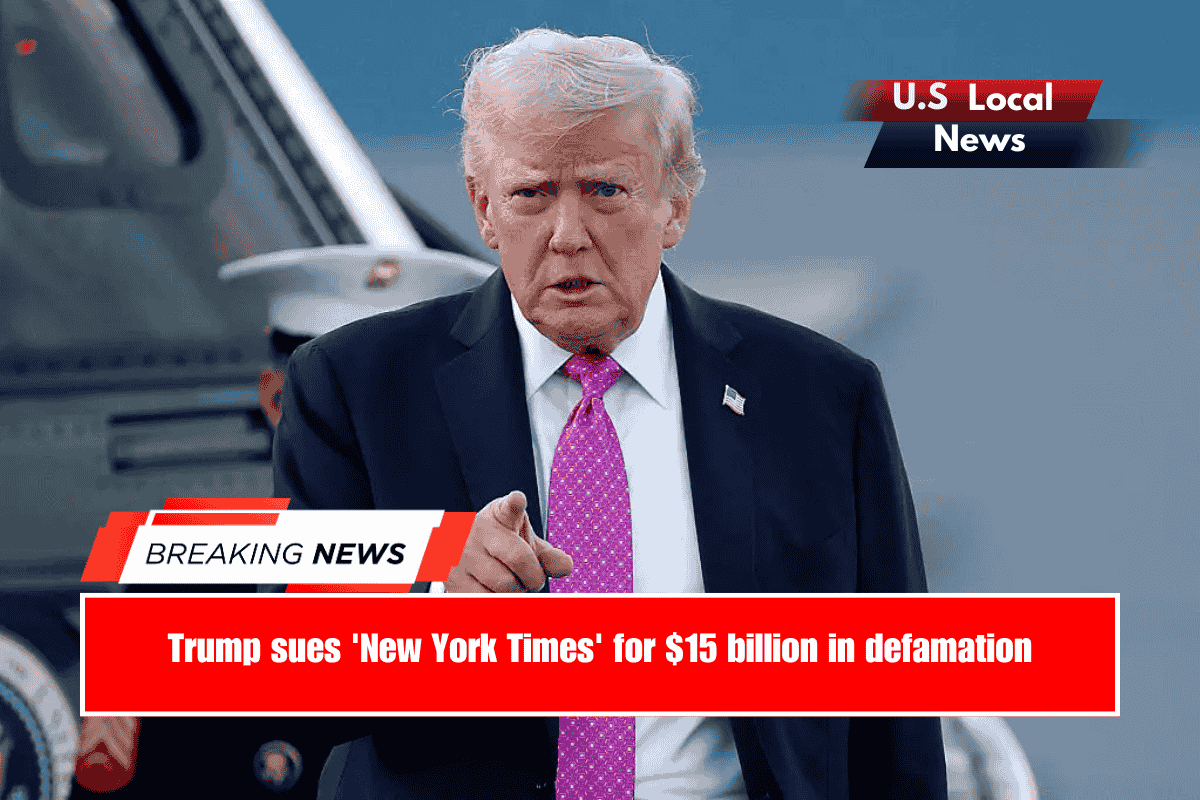
Late Monday, President Trump filed a $15 billion defamation lawsuit against the New York Times and some of its most prominent reporters over articles and a book alleging that he built his fortune and reputation in part through fraud.
The lawsuit also cites an interview conducted by the Times prior to last year’s elections. Retired US Marine Corps Gen. John F. Kelly, who was chief of staff during Trump’s first term, warned that Trump met the definition of a fascist.
Trump’s legal team also claimed that the Times incorrectly credited producer Mark Burnett with the success of the NBC reality show The Apprentice, rather than Trump, who hosted and starred in the show.
“Today, the Times is a full-throated mouthpiece of the Democratic Party,” Trump’s attorneys claimed in the filing.
A spokesperson for the New York Times Co. stated that the case is without merit.
“It lacks any legitimate legal claims and instead is an attempt to stifle and discourage independent reporting” according to the newspaper company. “Intimidation tactics will not stop the New York Times. We will continue to pursue the facts without fear or favor and defend journalists’ First Amendment right to ask questions on behalf of the American people.
Trump filed the case as a private individual in federal court in Tampa. The filing itself is full of praise for Trump as a politician, president, entrepreneur, and entertainer. It was filed by a team of attorneys who have previously represented Trump in lawsuits against major media companies such as ABC, CBS, and the Wall Street Journal.
On social media, Trump stated that the lawsuit is a significant expansion of his full-court press against the press.
“The ‘Times’ has engaged in a decades long method of lying about your Favorite President (ME!), my family, business, the America First Movement, MAGA, and our Nation as a whole,” he wrote. “I am PROUD to hold this once respected ‘rag’ responsible, as we are doing with the Fake News Networks such as our successful litigation against George Slopadopoulos/ABC/Disney, and 60 Minutes/CBS/Paramount.”
Public figures, such as the president, must meet a high standard to prove defamation in court. They must demonstrate that the defendants were aware that what they were publishing was false – or that they had serious doubts about the accuracy of those statements.
Nonetheless, Trump has avoided having to take his cases to court. When faced with his lawsuits, other major media companies agreed to settle.
The Walt Disney Co., ABC’s parent company, paid $16 million to settle Trump’s lawsuit over misstatements by anchor George Stephanopoulos.
CBS’s parent company, Paramount Global, paid the same amount to settle Trump’s lawsuit over the network’s editing of an interview with then-Vice President Kamala Harris, his Democratic presidential opponent. Paramount Global was seeking regulatory approval for its sale to Skydance Media at the time, which it quickly obtained.
Most recently, Trump sued the Wall Street Journal for reporting that he sent a lewd and sexually suggestive birthday message to disgraced financier Jeffrey Epstein two decades ago. Epstein died in jail while facing charges of sex trafficking involving minors. The Journal, which is owned by Trump’s political ally Rupert Murdoch, has pledged to fight the suit in court. It subsequently published a replica of the signed note, which Trump claims is a forgery.
The Trump administration has used regulatory powers to extract concessions from television networks. It has denied mainstream media access to coverage of the White House and the Pentagon. And it has persuaded the Republican-led Congress to withdraw all federal funding for public media, totaling $1.1 billion over the next two years, which Congress approved earlier this year and Trump signed into law.
The lawsuit names veteran investigative reporters Suzanne Craig, Russ Buettner, and Michael S. Schmidt, as well as the paper’s chief White House correspondent Peter Baker. Trump is also suing Penguin Random House for publishing a book about Trump’s financial rise by Craig and Buettner in September 2024, based on their newspaper reporting. They alleged that Trump committed massive tax fraud on his father’s inheritance, denied family members money owed to them, and structured his business fraudulently to avoid taxes.
Trump’s lawsuit was filed on the same day that his vice president and other senior administration officials paid tribute to the late Charlie Kirk on his podcast. They vowed vengeance against those on the left whom they blamed for creating the divisive environment in which the conservative activist was killed.
Former US President Theodore Roosevelt appears to be the last president to sue for defamation. He sued after the publisher of a small Michigan weekly newspaper reported that he had been intoxicated several times during his unsuccessful third-party bid for a third term in office.
According to a 2023 Washington Post account, the publisher was moved by a parade of witnesses who testified that Roosevelt, despite his boisterous demeanor, drank moderately; on the stand, the newspaperman withdrew his claims.
“In light of the defendant’s statement,” Roosevelt said, “I shall ask the court to instruct the jury that I seek only nominal damages. I did not enter this suit for money. I went into it with no vengeful intent. I have fulfilled my purpose, and I am satisfied.”